 Let's do
this with a simple example.
Let's do
this with a simple example.I write engineering design software for a living so I have a pretty good idea of what is needed to solve numerical problems. The thing about a numerical solution is that there is no room for vagueness. Unless of course you use fuzzy logic but I fail to see why my washing machine can not run for a set time.
One of my programs is a duct price calculator that is based mainly on metal cost per kg. The only hard part here is to calculate the duct area. For clarity in this article, I leave out the flanges and can show that the area of a straight rectangular duct is A = 2 × (H + W) × L. So, given the gauge and the density of steel, it is now easy to calculate the mass from
M = 8.04 × Gauge × A and the problem is solved.
The fittings follow a similar logic, but there is one fitting that is persistently difficult to handle. Yes, it is the square-to-round and I'm sure that the duct shops are nodding in agreement.
It makes no sense for me to go merrily ahead with some theoretical calculation if the duct shops already have the problem solved. I never discount the value of a good practical solution, so I have discussed (more like argued) this problem with a number of fabricators and have an equal number of solutions. This has prompted me to do some calculations to document the square-to-round model.
An accurate way to calculate the surface area of a complex sheet metal shape would be to develop it onto a flat surface and measure the various areas.
Let's do
this with a simple example.
We want the surface area of a 800 × 600 to 500 diameter × 1200 long square to round duct transition.
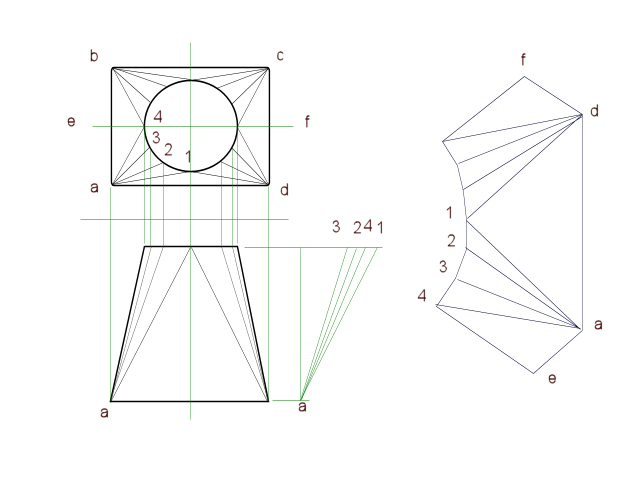
To prove the calculation, I will describe the development process.
To check that I'm not way off the mark, I made a paper sample.
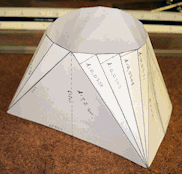
I know this is not a conclusive mathematical proof but it does give some confidence in the development process when the paper model is agrees with the elevation and plan.
By looking at each of the triangles on the development, we can now measure and sum to find the surface area.
OK, this is not really how I calculated the area. I just did this to confirm the magnitude of my result. I actually worked out each triangle area with good old geometry.
A1 = ½ W √ (L2 + ((H-d)/2)2) = 0.4804 m2
A2 = ½ H √ (L2 + ((W-d)/2)2) = 0.3628 m2
A3 = Π d / 8 √ (L2 + √((H/2)2 + (W/2)2) - d/2)2 )) = 0.2407 m2
A3 is an approximation to the curved triangles.
Using this method, I get A=2.649 m2
The measurements on my simple paper model give A=2.65 m2
By now, I can hear you asking a few questions:
"When am I going to get the time to go through this complicated calculation?". Well, you don't have to do that because the computer will do it for you.
"What about the flanges?" Don't worry, we will get there, the idea now is to prove the surface area calculation.
"That's all very well but I have to use a sheet of steel to do this and your measurement does not include the off-cut." Quite right, we are calculating the actual surface area. The reason is that we want the actual surface area for painting and the actual weight to calculate the installation cost. Remember, the off-cut is not installed and in any event the off-cut is accounted for by a waste factor. This will affect the cost but not the area and mass.
Having done a detailed calculation, I am still curious about the methods used by the duct manufacturers. The most common method is to use the perimeter of the rectangular section multiplied by an adjusted length.
Looking at the section, we see that the perimeter changes smoothly from rectangular to round and each of these lengths are easy to calculate.
P rect = 2 × (H + W) = 2 × (0.8 + 0.6) = 2.8 m
P round = π d = 3.14 × 0.5 = 1.57 m
P average = ½ ( P rect + P round ) = (2.8+1.57)/2 = 2.185 m
We can calculate the surface area from A = P average × L = 2.185 × 1.2 = 2.622 m2
This is only 1% lower than the accurate calculation. Since we used the face-to-face length, we would expect this area to be lower but the comparison seems to be very good.
In the accurate model above, we used a concentric transition. What if there was an off-set between the rectangular and circular faces? This would make the accurate model very complicated since the area of each face would have to calculated separately. Using the simple model, we could use the chord length from the centre of the square to the centre of the circle and get a reasonable answer.
For detailed calculations where the computer is doing the work there can be no excuse for using simplified equations. The reason for calculating the actual surface area is that it reflects on the actual weight and therefore the installed cost. Waste can be effectively dealt with by applying a waste factor to the price where it belongs.