Duct Design by static regain
by: Bruce Wernick
Last Updated: 28 January 2010
This article gives a brief exploration of the static regain method. I pose some of the
common questions that I have had from air-conditioning designers and attempt to
give concise answers.
If you would like to add a question (or make a correction), please feel free to
send me an email.
What is the reason for using the static regain method?
The basic idea behind static regain is that the static pressure at each take-off will be the same.
Why is this useful?
Because each outlet will have an equal pressure and therefore the system will not need balancing.
My experience is that very little balancing actually happens on site so this
is a big advantage.
Does static regain work?
In theory, yes, but I have seen no measurement to prove it in practice.
My opinion is that the extra effort and the lack of proof makes the static
regain quite questionable. The equal friction method is so much easier and
gives reasonable pressures.
If you really want to size the ducting to make a difference then you should
rather look at a life cycle costing (LCC) method.
How does it work?
The total pressure in the duct is equal to the static pressure plus the dynamic pressure.
Pt = Ps + Pd
So, to increase the static pressure, you just need to drop the dynamic pressure.
How do you drop the dynamic pressure? Easy, by increasing the size of the duct.
The idea is that you size a length of duct (from take-off to take-off) by making sure that the velocity pressure drop is equal to the static pressure drop in the duct length.
This means that you will compensate for the frictional pressure loss and the static pressure at the outlet will be the same as it is at the inlet.
Can you give a real example?
You must start at the fan outlet duct with certain size duct. Usually, you would decide on the main duct velocity.
Let's do a simple example.
Say you have a simple duct run with 4 outlets. Each outlet will have a design airflow of 300 l/s. This means that the fan must supply an air volume flow rate of 1.2 m3/s.
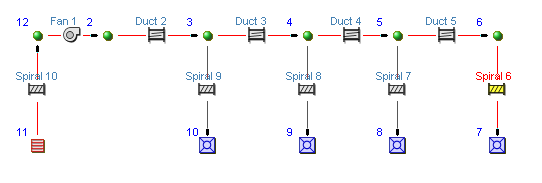
Figure 1. Simple duct run
For this example, we will choose an airflow of 10 m/s in the first duct. From this, we can calculate the cross-sectional area of the starting duct.
A = Q / V = 1.2 / 10 = 0.12 m2
To keep it simple we will assume that the duct is square, so the W = H = 346 mm
We can now size Duct 3 by the static regain method.
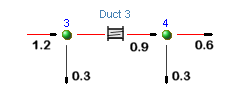
Duct 3 friction: dp = ½ ρ f L3 v32 / d3
Dynamic pressure from duct 2 to duct 3: dp = ½ ρ (v22 - v32)
The only unknown is d3. The problem is, we don't know v3 because it also depends on d3 , so we have to do a little bit of trial and error at each step.
Note: We use the equivalent diameter because all regain calcs are based on
equivalent round duct (and equivalent round duct velocity).
If d3 = 387 mm
dpf = 0.5 x 1.2 x 0.0183 x 20 x 7.642 / 0.387 =
33.1 Pa
dp2-3 = 0.5 x 1.2 x (10.652 - 7.642) =
33.03 Pa
Lucky, I made a good starting guess. Now all you have to do is repeat this process for the remaining ducts.
Are there any disadvantages to the static regain method?
Yes...
- It's difficult to calculate. Try to do a big network with your
calculator and you will see what I mean.
- The duct sizes towards the end of the duct runs tend to get a little big as you run out of velocity head.
How do you deal with parallel ducts?
It is an iterative process to find the duct run from the inlet to the outlet that has the highest pressure drop. This is the index run. All of the other paralled duct runs from inlet to outlet will have a lower pressure drop and therefore will need dampers to balance the flows.
To be perfectly honest, I have never done a big statis regain system by manually. The DuctNet software from TechniSolve Software does such a good job and it's easy to check.
What about fittings?
The pressure drop of the fitting is included with the duct static.
If is wasn't included then the static at the node will be lower than the
previous node, thus defeating the purpose.
What about the diffuser?
Diffusers are not included in the static regain calculation.
The reason is that we calculate the static pressure up to the diffuser inlet
(so that each diffuser "sees" the same pressure).
The actual diffurer neck is sized on the basis of flow, so we don't include these in the duct size calculation.
What is the regain factor?
In the example above, I said that the dynamic pressure must be reduced by
exactly the same value as the friction. From this, we conclude that the
static pressure will be the same before every junction.
But, in practice, we are not able to recover all of the dynamic pressure.
Carrier have suggested that we are only able to recover 70% to 90% of the
dynamic pressure.
This term is the regain factor, f. (I have seen it reported in the
litterature that there is so much uncertainty in this method that is makes no
sense to include a regain factor. for this reason, I use f = 1.00)
Now we have : f · (dP1 - dP2) = dPf-2
Copyright © 2010 TechniSolve Software All rights reserved...