Author: Bruce Wernick
Last updated:
11 November 2015
The definition of the thermodynamic wet bulb temperature can be used to calculate the entering air humidity.
We start with the ideal arrangement known as an adiabatic saturator shown in figure 1. The walls are insulated so there is no heat flow, the outlet air is saturated and the make-up water is arranged to be equal to the leaving air wet bulb temperature.
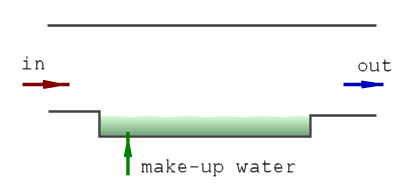
Figure 1. Theoretical adiabatic saturator
Unsaturated air enters and gains moisture from the sump. We solve the system by applying a energy and mass balance.
Energy IN = Energy OUT
and
mass IN = mass OUT.
ma hai + mw hw = ma hao .......Energy conservation
mw = ma (wao - wai) .......Mass conservation
Substitute mw into the energy equation
ma hai + ma hw (wao - wai) = ma hao
and cancel the common air mass flow
hai + hw (wao - wai) = hao
Rearrange (and notice the new property)
hai - wai hw = hao - wao hw ....Sigma Heat equation
Before going further, it is worth looking at this equation. The term (ha - wa hw) is property that we call the Sigma heat. Notice that it is the same at inlet and outlet. In other words, the adiabatic saturation process is also a constant sigma heat process.
za = ha - wa hw
za = ha - wa cpw wb
But the inlet enthalpy can be defined as
hai = Cpa dbi + wai hwvi
and similarly, the leaving air enthalpy is
hao = Cpa dbo + wao hwvo
Substitute for hai and hao
(Cpa dbi + wai hwvi) - wai hw = (Cpa dbo + wao hwvo) - wao hw
Rearrange...
Cpa dbi + wai (hwvi - hw) = Cpa dbo + wao (hwvo - hw)
Now, we can solve for wai...
wai = [wao (hwvo - hw) + Cpa (dbo - dbi)] / (hwvi - hw)
All of the unknown values can be read directly from the saturation tables.
wao = ws(wb) ...Saturation humidity at the wet bulb
dbo = wb ...Saturated at outlet (leaving dry bulb = web bulb)
hwvo = hg(wb) ...Saturated water vapor at wet bulb temperature
hwvi = hg(db) ...Saturated water vapor at dry bulb temperature
Finally...
wai = [ws(wb) (hg(wb) - hw) - Cpa (db - wb)] / (hg(db) - hw)
This is the equation that links the moist air state properties. So, given (Pa,db,wb), we can now calculate wa and therefore all of the other properties explicitly.
Example...
Given db=35°C and wb=25°C at Pa=101.325 kPa
| t | ws |
|---|---|
| 25 | 0.020170 |
| 35 | - |
| t | hf | hg |
|---|---|---|
| 25 | 104.81 | 2546.47 |
| 35 | - | 2564.53 |
wa = [0.020170 (2546.47-104.81)-1.006 (35-25)]/(2564.53-104.81)
= 15.932 g/kg
Our original equation allows for the direct calculation of wa from db and wb. Now, we need to use db and wa to get the wet bulb temperature.
Here, Sigma heat gives the ideal choice of property. Sigma heat is a property that is constant for a given wet bulb. So all we need to do is find wb such that the Sigma heat is equal to that at saturation.
Sgi = Cpa db + wai (hg,db
- hw)
Sgo = Cpa wb + wsw (hg,wb
- hw)
We know that wb <= db so a valid starting guess would be wb=db. We also know that wb >= dew point so this is a good 2nd guess. From there, we will interpolate between the last two values.
Example...
Given db=35.0C and wa=15.946 g/kg, calculate wb.
| step | wet bulb | Sgo-Sgi |
|---|---|---|
| 1 | 35.000 | 50.385 |
| 2 | 21.209 | -14.289 |
| 3 | 24.256 | -2.974 |
| 4 | 24.855 | -0.585 |
| 5 | 24.971 | -0.113 |
| 6 | 24.994 | -0.022 |
| 7 | 24.998 | -0.004 |
In our derivation of the adiabatic cooler, we calculated the entering air humidity Wai.
Another useful arrangement would be to calculate the entering dry bulb, given the humidity.
Cpa db + wai (hg(db) - hw) = Cpa wb + ws(wb) (hg(wb) - hw)
Can you see the problem here?
The entering water vapor enthalpy is a function of dry bulb so it can't be extracted.
As a reasonable simplification, we can use a linear fit of enthalpy vs temperature
hg = Hgo + Cpv db
Cpa db + wai (Hgo + Cpv db - hw) = Cpa wb + ws(wb) (hg(wb) - hw)
That's better, now we can rearrange for db to get...
db = [Cpa wb + ws(wb)(hg(wb) - hw) - wai (Hgo - hw)]/(Cpa + wai Cpv)
Let's test our assumption...
Given wb = 25.0°C and Wai = 15.000 g/kg
db = (1.006×25.0 + 0.020170×(2546.47 - 104.81) - 0.015×(2500.77 - 104.81)) / (1.006 + 0.015×1.82)
= 37.21947°C
Using db = 37.21947°C and wb = 25.0°C gives Wa = 15.002 g/kg
I would say that a 0.013% error is acceptable.
Copyright © 2011 TechniSolve Software All rights reserved...